Friday, November 9, 2018

How to make Christmas cake

1 Mix and match
A note about ingredients: those listed are my preferred mix of dried fruit and nuts, but fruitcake is a very personal thing, so feel free to substitute your own blend –sour cherries or cranberries instead of glace fruit; chopped dates or apricots instead of figs; a simple bag of supermarket mixed fruit – so long as you keep the total weight the same.

2 The trick to a moist cake

Many people claim they don’t like fruitcake because it’s dry. Avoid this by soaking the dried fruit and peel in either whisky (or cold tea or fruit juice, if you’d prefer to keep your cake teetotal). Cover and leave to steep for six to 12 hours – I usually do this the night before I’m planning to bake.

3 Be protective
Grease and line a 20cm springform cake tin with two layers of baking paper: this may seem unnecessarily fiddly, but it will prevent the outer layers from burning – very handy when you’re baking with dried fruit, which has a tendency to catch and become very bitter where it sticks out from the sides of the cake.

4 Get creaming
Put the butter and sugar in a large bowl and cream together until very light and fluffy; I’d recommend using electric beaters for at least five minutes until it has significantly increased in volume. Gradually add the eggs, beating well between each addition so the mix doesn’t curdle.

5 Add the spices

Sift the flour into another large bowl, then whisk in the baking powder, spice, ground almonds and a pinch of salt. If you’re not a fan of mixed spice, or don’t have it to hand, you can substitute vanilla extract or other sweet spices, though bear in mind that the likes of nutmeg and cardamom are very strong, so go easy with them.

6 Mix together
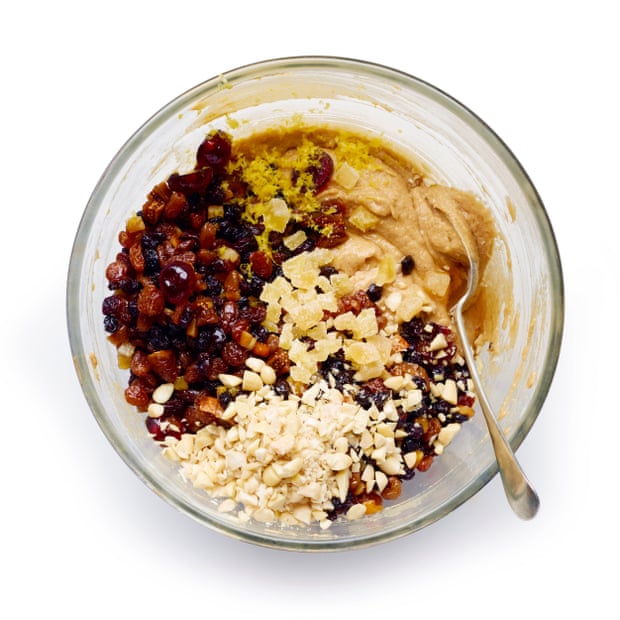
Fold these dry ingredients into the butter and sugar mixture, along with the soaked fruits and any remaining soaking liquid, lemon zest, chopped almonds (again, use other nuts or leave them out if you prefer) and ginger, if using. You can leave it out if you like, but it does give the cake a lovely burst of heat.
Thursday, September 27, 2018

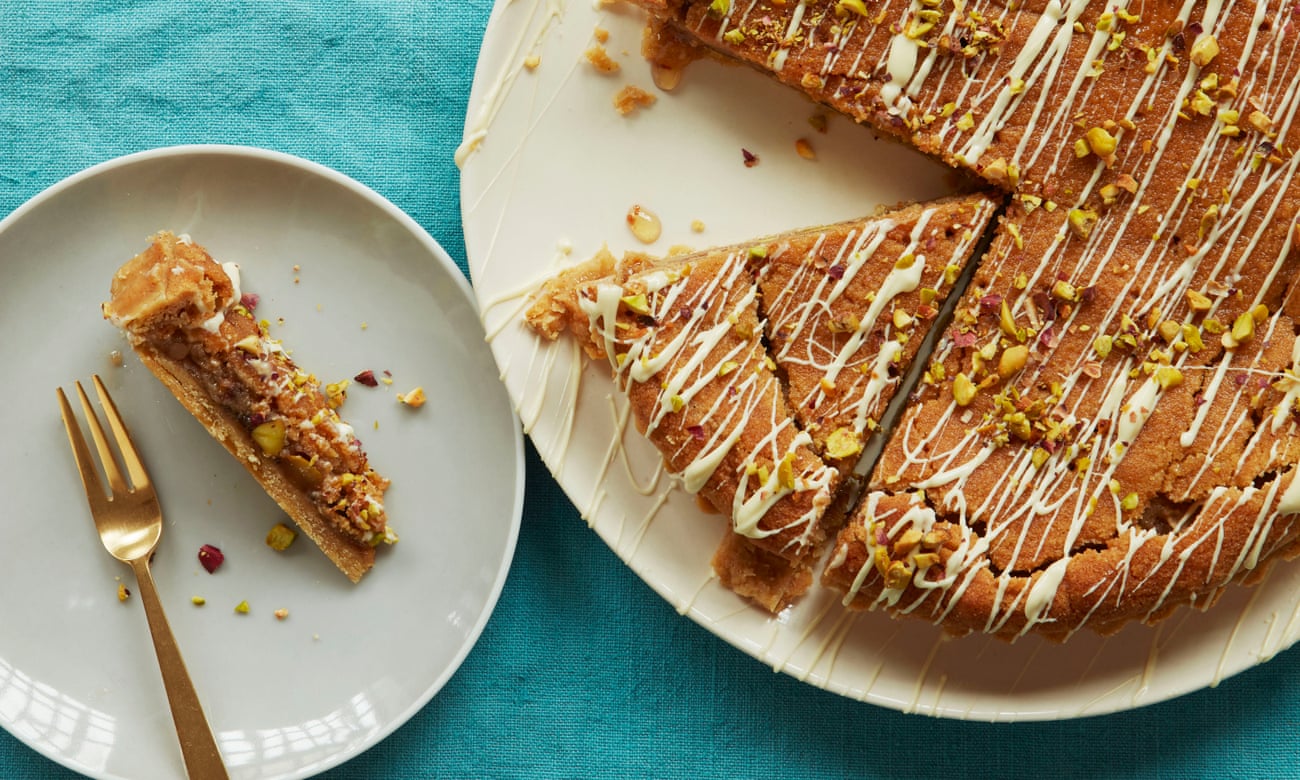
Liam Charles’s recipe for pistachio butter and fig jam tart

Heat the oven to 200C/390F/gas 6, then start the pastry. Put the flour, butter, orange zest and mixed spice into a food processor, then blitz until the mix resembles fine breadcrumbs. With the motor running, add the egg yolk, icing sugar and the water, until the dough is just starting to come together. Tip it on to a lightly floured surface, give it a quick knead, then bring together into a smooth ball. Flatten the pastry into a thick disc, wrap in clingfilm and chill for 30 minutes.

Next, make the filling. Put all the ingredients apart from the nuts and jam into a food processor and blitz until smooth and creamy. Put a baking tray in the hot oven.

Take the pastry out of the fridge, put on a lightly floured surface and roll out to 2-3mm thick. Lift the pastry into a 20cm fluted tart tin and press it into the corners – be gentle – leaving a 1cm overhang. Trim the excess pastry with scissors, cover with baking parchment and baking beans, put the tin in the oven on to the baking tray, and bake for 18 minutes.

Remove the parchment and beans, and put the pastry back in the oven for another five to seven minutes. Take out of the oven and use a small serrated knife to trim the pastry to the height of the tin. Turn down the oven to 180C/350F/gas 4.

Spoon the jam on to the pastry and spread to the edges, top with the pistachios and walnuts, then cover with the filling, spreading to the edges to cover the fig jam. Bake for 45-50 minutes, until the sponge is cooked and a skewer comes out clean.

While the tart is still hot from the oven, poke small holes in the surface and then very gently spread a drizzle of runny honey over the top. Cool the tart in the tin for 20 minutes, then put it on a wire rack to cool completely. Take the tart out of the tin, give it a good squiggle of white chocolate, and sprinkle with the extra nuts.

Wednesday, August 29, 2018

Jaffa cakes are 50% sugar, but what’s in the other half?

Ever since hearing that the England football team takes Jaffa cakes when it goes on tour, I've looked at them with fresh eyes. What is it about the spongy treat that makes it so popular? If athletes eat them, does that mean they qualify as a healthy option?
Jaffa cakes were first made by McVitie's and Price in the UK in 1927. The original was a little sponge topped with jam and a layer of chocolate. There is quite a lot more in there now however. There are also a lot more brands, though the distinction between them seems to be on price and marketing, rather than recipe, with own-brand Jaffa cakes from Jacob's, Aldi, Lidl, Centra, Supervalu and Dunnes, for example.
So what's the difference?
McVitie's wins on marketing. The packaging even mentions its Jaffa cake Facebook page, which has thousands of followers. It also says: "To find out how exercise and a balanced diet can help a healthy lifestyle" That is a fairly standard website run by United Biscuits, which owns McVitie's and is in turn owned by Yildiz Holding, a Turkish food conglomerate. It dishes out uncontroversial advice to eat a balanced diet and get some exercise.
Starch industry
When it comes to ingredients, McVitie's sets the tone and lists more than 30. It's hard to give an exact number and some are mentioned as "and/or". So they may or may not be there. The first ingredient on the list is glucose-fructose syrup and it makes up at least 19 per cent of the ingredients, though probably much more. In the European Union, the fructose content of glucose-fructose syrup is usually about 20 to 30 per cent and it is made from wheat or maize,according to the Starch Europe, a trade association that represents the interests of the starch industry. In the United States, it is often known as high-fructose corn syrup as it is predominately made from corn, and can be up to 50 per cent fructose. So it is similar, though not the same, as the type of sugar used in fizzy drinks in the US. Manufacturers love it because it can provide texture, volume, taste, glossiness, improved stability and a longer shelf life.

Wednesday, July 18, 2018

Utca erupts onto Calgary food scene with Transylvanian street eats

'It's not fast food, it's fun food, If you want to come in, just relax and enjoy yourself'
If you've never tried Transylvanian food, head to Victoria Park for some chimney cakes.

The sweet and savoury tube and cone-shaped cakes have eastern European origins. They are made of soft yeast dough, wrapped around a wooden cone or cylindrical mould on the end of a spit and baked rotisserie-style over hot coals in a fire pit, in the intense heat of a barbecue or in a special oven designed for the job.

Yadira and Guillermo Rivas first came across chimney cakes at a mall kiosk in Saudi Arabia. Their kids loved them and the family would get them as a special treat every weekend.
The couple met while working at BP — he was an engineer, she was in finance. Their careers brought them to Venezuela, Calgary and Saudi Arabia, but when a dream job turned out to be less than dreamy, they pondered bringing chimney cakes to Canada.

The couple explored the business concept to the point where Guillermo traveled to Budapest, where chimney cakes are a popular Hungarian street food, to learn how to make them from scratch.

When the Rivases eventually returned to Alberta, they found Calgary in the midst of the economic downturn and it was difficult to find jobs.
"When we came to Calgary we had Plan A, B and C. This was Plan B that suddenly became Plan A," says Guillermo of their new chimney cakes and coffee house.

"And until this past February I knew nothing about coffee, so I went to Vancouver to train to be a barista and become certified."

Knowing Calgary is supportive of small businesses and open to new food ideas, they opened in a new building in at 207 13 Ave. S.E., with branding done by a designer they knew in Venezuela.

Utca — pronounced ootsa — translates to "street" in Hungarian.

Yadira and Guillermo make the dough themselves and bake the chimney cakes one at a time in ovens imported from Slovenia. The dough is coaxed off their moulds while they're still warm enough to release their trademark wisp of steam, making them resemble a smoking chimney.

The sweet ones are brushed with a little oil and sprinkled with sugar before baking for a slightly crunchy, caramelized exterior. The savoury cheese chimney cakes are filled with ingredients like scrambled eggs, sausage and cheese for a breakfast you can eat out of hand, perhaps with a latte made with beans from nearby Rosso Coffee Roasters.

The most popular cones at Utca are rolled in sprinkles, coconut or other flavoured coatings, then filled with a variety of sweet additions, like caramel drizzles or Nutella spread before swirling in chocolate or vanilla soft serve from Fiasco Gelato.

"It's a bit more expensive than if we just got any kind of ice cream, but it's especially important to us right now to work with local small businesses, and keep the money circulating within our own city," Guillermo says.

Friday, June 29, 2018

This Fourth of July, try a red, white and blue poke cake

Although poke cake is usually in the form of a sheet cake, we thought it could make a beautiful and festive layer cake for the Fourth of July.
For a cake that was red, white and blue all the way through, we started by cooking blueberries and strawberries and then combining each with gelatin to create two colorful, brightly flavored syrups.
We used a simple white cake as our base; it was tender and flavorful but also had enough structure to handle a syrup soaking. We used a skewer to poke holes into the cake layers while they were still in their pans and then drizzled the blueberry syrup over one layer and the strawberry syrup over the other. A simple filling and frosting of whipped cream kept this cake light and refreshing for the summer holidays.
 Find more recipes like Patriotic Poke Cake in "The Perfect Cake."

Friday, March 23, 2018

Lemon Blueberry Mousse Cake

This isn't you average Delish doctored cake mix recipe, and it's not one of our crazy decadent cheesecakes either; all of those have time and a place. This is different. It's the dessert you need to make when you really want to impress.
                                                     

I won't lie to you. A cake this amazing takes some work (and time!). But when you break down the recipe step-by-step, it's far less intimidating than you might think.

First, make the Nilla Wafer crust. Crush the cookies, mix them with melted butter and press it all into a springform pan. Done.

Next, make the mousse. Start by pureeing blueberries then stir in lemon zest and lemon juice. Sprinkle a packet of gelatin on top and let it sit until softened, 5 to 10 minutes. While it's setting, make white chocolate ganache. (It's not as thick as ganache, but the process is pretty similar.) Pour hot heavy cream over white chocolate chips and stir until smooth. Let cool slightly, then fold in the blueberry gelatin mixture. Stick this in the fridge while you make whipped cream.

Yes, you might as well whip your own cream. In the grand scheme of things, it's a small extra step that makes a big difference. Once the whipped cream is nice and fluffy, add the white chocolate blueberry mixture and fold until it's a pretty shade of violet. Voila! You have lemon blueberry mousse! Pour mousse mixture over crust and refrigerate until set, about 4 hours.

Last but not least, make the sugared blueberries. When just washed (and not dried thoroughly), sugar will stick to the berries very nicely. (Though we add a touch of lemon juice to balance out the sweetness.